
F.A.Q.
Find answers to the most frequently asked questions related to the science of osteopathy.
Is osteopathy related to our bones, as the name implies?
This is a valid and very common misconception. If one looks it up in the dictionary, the prefix “osteo-” is defined as “relating to bones,” and many medical conditions that begin with “osteo-” are indeed associated with bones and joints (e.g., osteoarthritis, osteoporosis).
However, osteopathy does not focus on a single part of the body or exclusively on the bones. Practitioners treat the body as a whole, taking into account all its systems and how they interact with one another.
So why is it called osteopathy? The term was coined in the 19th century by Andrew Taylor Still, the founder of osteopathy, because it was initially believed that bones played a central role in health. Of course, modern osteopathy has a much broader and more holistic approach.
How should I prepare for our first appointment?
Proper preparation for your appointment with an osteopath is important to help you get the most out of your session.
1. Focus on your symptoms: Write down the symptoms or pain you are experiencing, as well as when they began. This will help the osteopath better understand your condition.
2. Wear comfortable clothing : Choose clothes that allow easy movement and avoid tight or restrictive garments.
3. Avoid heavy meals beforehand : Try not to eat a large meal right before your appointment, as it may cause discomfort during treatment.
Shall I bring my medical scans with me?
You may bring your medical report and actual imaging results if you wish, but this is not necessary, as the osteopath takes a comprehensive medical history and performs their own examination in order to assess and evaluate your condition.
How should I be dressed for our appointment?
It is recommended to wear comfortable clothing (such as sportswear, like tracksuits or leggings) so you can move easily during the examination and treatment.
The osteopath will often observe and analyze your posture, as well as palpate the tissues, so you may be asked to remove some of your clothing, as well as jewellery and earrings, in order to better assess your body’s posture and movement patterns.
How long does an initial consulation last?
Approximately 60–70 minutes. During the first consultation session, I will write down your medical history and ask you questions related to the reason for your visit, your overall health, and your lifestyle.
This will help me gain a comprehensive understanding of your condition so that, through treatment and the guidance provided, I can support the improvement of your condition. If necessary, I will refer you to a medical specialist.
Can you describe what our first meeting would look like?
After discussing your lifestyle and taking your medical history, a clinical examination will be carried out, including palpation, movement assessment, and various other tests (orthopaedic and neurological examinations), in order to identify the factors that may be contributing to your condition and how they can be addressed.
It is helpful to remember any medications you are taking, as well as any details from your medical history that may be related to your current issue at hand. An assessment will then be made and discussed with you, so you can better understand the approach to your condition and the treatment plan, and give you enough space to ask any questions before the treatment begins.
When the appointment concerns children, questions will be addressed to both the child and the parents. If there are any additional examinations you have already carried our, or relevant medical history, it is important to mention them. The examination is no different to that of adults. For younger children, I will observe while they play or move around the room. This will be followed by palpation, either with the child on the treatment table or in the parents’ arms. This stage is needed in order to gather further information about the condition of the body’s tissues. An assessment will then be discussed with the parents before any treatment begins. The examination and treatment are not painful for the child, as the techniques used are gentle and osteopathic practitioners have extensive experience with paediatric care.
For infants, questions will be directed to the parents, who will also be asked to provide details regarding the pregnancy, birth, and the baby’s medical history. The examination will be carried out to gather information from the tissues and the movement of the body. If the issue we are dealing with is related to breastfeeding, you may be asked to breastfeed during your visit. Treatment may take place on the treatment table, in the parents’ arms, or in the osteopath’s hands.
What will my child’s first appointment look like?
First of all, as mentioned above, I will take a detailed medical history covering the pregnancy, birth, and the child’s overall health.
This is followed by an examination, during which—depending on the child’s age—I will assess specific passive and active movements, check developmental milestones, reflexes, and muscle tone.
After discussing the findings together, I will proceed, if necessary, with treatment, which involves gentle techniques aimed at helping the baby’s or child’s body relax as much as possible so they feel comfortable.
In some cases, I may also provide advice or exercises as “homework”, and if needed, I will refer you to another healthcare professional. In certain cases, one session may be sufficient, while in others, more sessions may be required.
It is important to note that for the first appointment, the child must be accompanied by at least one parent. For any follow-up sessions, if needed, some children over the age of 12 may attend on their own.
Can you describe an osteopathic session to me?
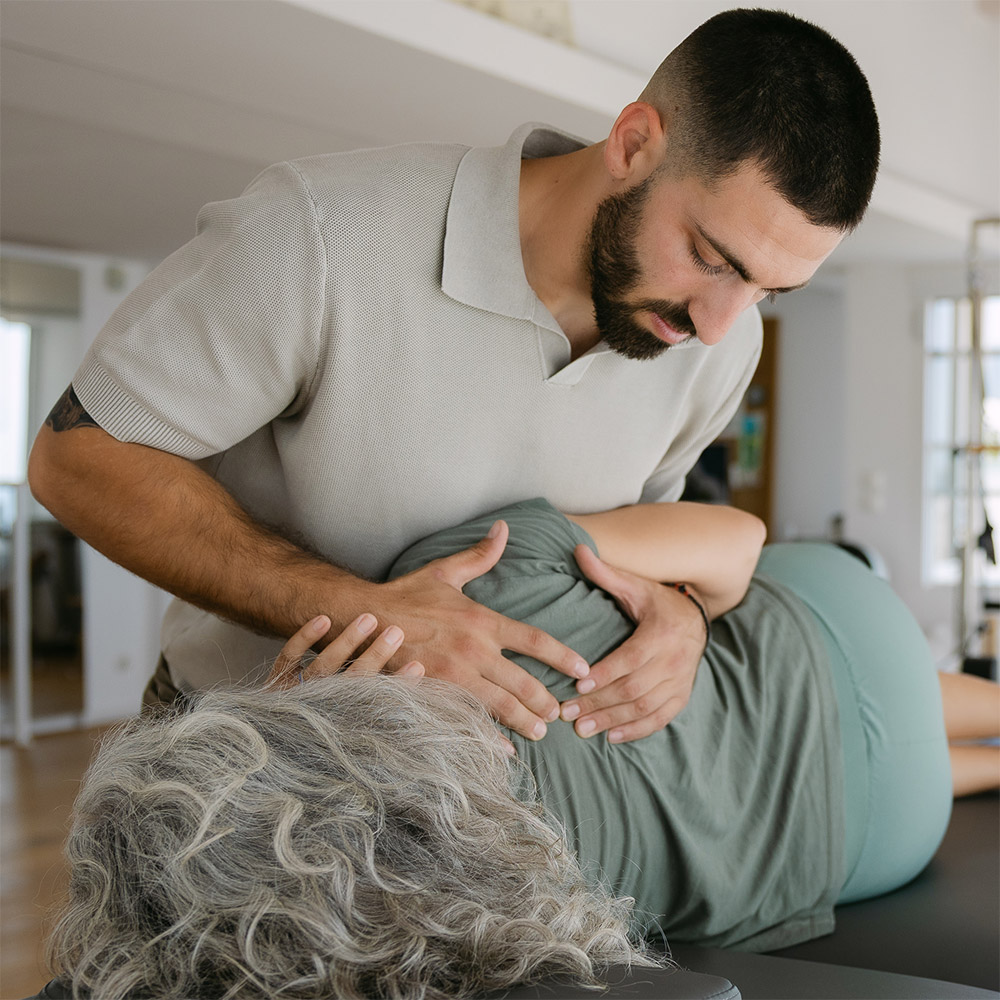
Therapists work with their hands, and a session typically involves a combination of techniques such as:
- Rhythmic joint mobilisations and manipulations (yes, you may hear various “clicking” sounds) to restore joint mobility.
- Massage and “pumping” techniques to improve the circulation of body fluids and support tissue health.
- Myofascial stretching techniques to restore the normal length and structure of tissues.
- Acupuncture, if considered necessary.
So, does the osteopath perform some kind of massage?
Although massage may form part of an osteopathic treatment, it is only one of many techniques used to address the underlying causes of a problem. It should be noted that osteopathy and therapeutic massage are not the same: While therapeutic massage primarily focuses on manually working the soft tissues in order to promote relaxation and relieve tension, osteopathy focuses on functional imbalances within the musculoskeletal system that may be contributing to symptoms.
Osteopathic practitioners use a wide range of techniques, such as joint mobilisation and stretching, to improve tissue function and support the body’s healing process. The techniques applied depend on each patient’s condition and individual needs.
Is it possible that I go in for a specific health issue and, during our appointment, the osteopath discovers other issues that I have not yet noticed?
In the human body, all anatomy and physiology are closely interconnected. Osteopathy uses a holistic approach to identify the root cause of a problem, which may not be immediately apparent or may be hidden behind other symptoms.
How similar is osteopathy to physiotherapy or chiropractic treatment and what are the differences?
Osteopathy shares some common elements with chiropractic and physiotherapy, but what primarily distinguishes it is its philosophy and its holistic approach to the human body.
According to the four core principles of osteopathy described here, its aim is to help the body regain homeostasis and initiate self-healing. Treatment is mainly carried out with the osteopath’s hands, through mobilisation, manipulation, and massage techniques, working through the musculoskeletal system to create a relation to the body’s other systems.
Physiotherapy treatment may involve the use of special equipment, massage, and exercises; chiropractic treatment focuses on spinal adjustments; whereas osteopathy does not focus solely on obvious symptoms. Instead, it approaches the patient as a whole, aiming to identify the mechanical or functional reasons that originally caused the problem at hand.
Can I book an appointment even though I have no health issues at the moment?
It is not necessary to have a specific condition in order to benefit from osteopathy. Its main focus is the prevention of disorders and injuries, and for this reason it is often used to improve the overall function of the body, supporting homeostasis and the body’s readiness to adapt to any internal or external changes.
Osteopathy has been shown to contribute to improved circulation throughout the body, reduced stress levels, and better regulation of the nervous system, allowing the organism as a whole to function more efficiently.
Does an osteopath spot the problem straight away?
Many problems can be identified from the first appointment, but there are also many cases where certain symptoms may be masking other underlying imbalances or dysfunctions, which only become apparent once the initial dysfunctions have been properly addressed and regulated.
How many appointments would you say are helpful to a premature baby?
The number of appointments depends on many factors, including the pregnancy and the mother’s health, the reasons for a premature birth, the delivery itself, and the condition of the infant’s overall health.
After carrying out my assessment, I will be able to provide an indication of the treatments that may be required, along with additional advice to support the baby’s best possible development.
What is the difference between pediatric osteopathy and cranial osteopathy? Is cranial osteopathy only practiced on babies?
Pediatric osteopathy refers to osteopathic treatment designed for infants and children.
Cranial osteopathy is only one of the techniques used by osteopaths, depending on the needs of the patient. It is a particularly gentle approach and, for this reason, is considered highly effective and well-suited for babies and children.
The treatment uses subtle, gentle movements to influence the circulation of bodily fluids, relax tissues, and help restore the craniosacral rhythm, allowing the body to initiate its self-healing processes.
Cranial osteopathy can be used for people of all ages, regardless of condition or injury, and it is often preferred for infants because it is the least invasive and most easily tolerated form of treatment.
Is cranial osteopathy the same as craniosacral therapy?
They are very similar and share the same core principles. However, cranial osteopathy is generally considered a more advanced clinical approach that requires additional training and deeper knowledge.
How often should I book an appointment?
Frequency varies from person to person and depends on the nature and severity of the condition.
Some people take a preventative approach and choose to come once a week or once a month. Others book appointments only when a problem arises.
As a general rule of thumb, when there are symptoms such as stiffness or pain in the neck, back, or shoulders, one or two sessions are often enough to produce noticeable improvement.
Osteopaths typically avoid performing more than one treatment per week, as the body needs time to process and integrate the effects of treatment. Once the issue improves, visits may be reduced to once a month, every two months, or three to four times per year. Regular check-ups can help reduce both the frequency and intensity of pain or tension flare-ups.
Does it hurt? Are there any side effects?
Techniques are usually gentle, although they may include deeper tissue work. This means that mild soreness or tenderness, similar to post-exercise muscle fatigue, can sometimes occur for a day or two after treatment.
Serious side effects (such as brain-related vascular issues related to spinal manipulation) are extremely rare. For this reason, it is important to seek care from properly trained osteopaths who perform appropriate safety assessments before treatment.
Is osteopathy safe, especially for people with heart conditions?
Osteopathy is considered safe for everyone, as the clinical examination and treatment plan are tailored individually based on each patient’s needs and medical history. In some special cases, your osteopath may ask you to consult your doctor to rule out any contraindications.
Is it safe during pregnancy?
Not only is it safe, but it can also be highly beneficial. During pregnancy, a time when the body undergoes some of its greatest changes, osteopathy offers a gentle and effective approach to managing pain, discomfort, and physical strain related to the growing baby.
It can also help the body recover after childbirth, support pelvic balance, and assist with discomfort and physical stress related to breastfeeding and holding the baby.
How safe is pediatric osteopathy?
It is very safe. It is a gentle, non-invasive and effective treatment suitable for babies and children at all stages of development.
What do the initials M.Ost, APO, CPO, DPO, next to your name, mean?
These are academic qualifications. M.Ost stands for Master of Osteopathy, APO stands for Award in Paediatric Osteopathy, CPO stands for Certificate in Paediatric Osteopathy, and DPO refers to Diploma in Paediatric Osteopathy.
Osteopathy is a search for communication and cooperation with the natural laws of healing.
JAMES JEALOUS